
One percent sounds like nothing. On a $500,000 portfolio, it's $5,000 a year — charged whether your investments go up or down. And because every dollar paid in fees is a dollar that stops compounding for you, the real damage over a career stretches into six figures. Here's the math, where the fee hides, and how to check yours in about ten minutes.
What an expense ratio actually is
The expense ratio is the annual percentage a fund charges to cover its own costs: the manager's salary, administration, marketing. You never get a bill — it's deducted silently from the fund's returns before you ever see them. If a fund's investments earn 7% in a year and its expense ratio is 1%, you keep roughly 6%.
That "roughly" matters more than it looks, because the fee doesn't just reduce this year's return. It reduces every future year's return too, since there's less money left to compound.
The SEC did this math for you
The SEC's Office of Investor Education published an Investor Bulletin on how fees affect your portfolio with a simple illustration: $100,000 invested, growing 4% a year for 20 years.
- 0.25% annual fee — ends at about $208,000
- 0.50% annual fee — ends at about $198,000
- 1.00% annual fee — ends at about $179,000
Same market. Same 20 years. The only difference is the fee — and it carves nearly $30,000 off the ending balance, close to 30% of what you started with. As the SEC puts it: "Fees may seem small, but over time they can have a major impact on your investment portfolio."
Stretch it over a full career
The SEC's example uses 20 years. Most of us invest for 30 or 40. Here's a hypothetical illustration — my own calculation, not a prediction of what markets will do: invest $10,000 a year for 30 years at a 7% average gross annual return.
- 0.10% fee (typical broad-market index fund) — ends at $927,782
- 1.00% fee (typical actively managed fund) — ends at $790,582
The gap: $137,200.
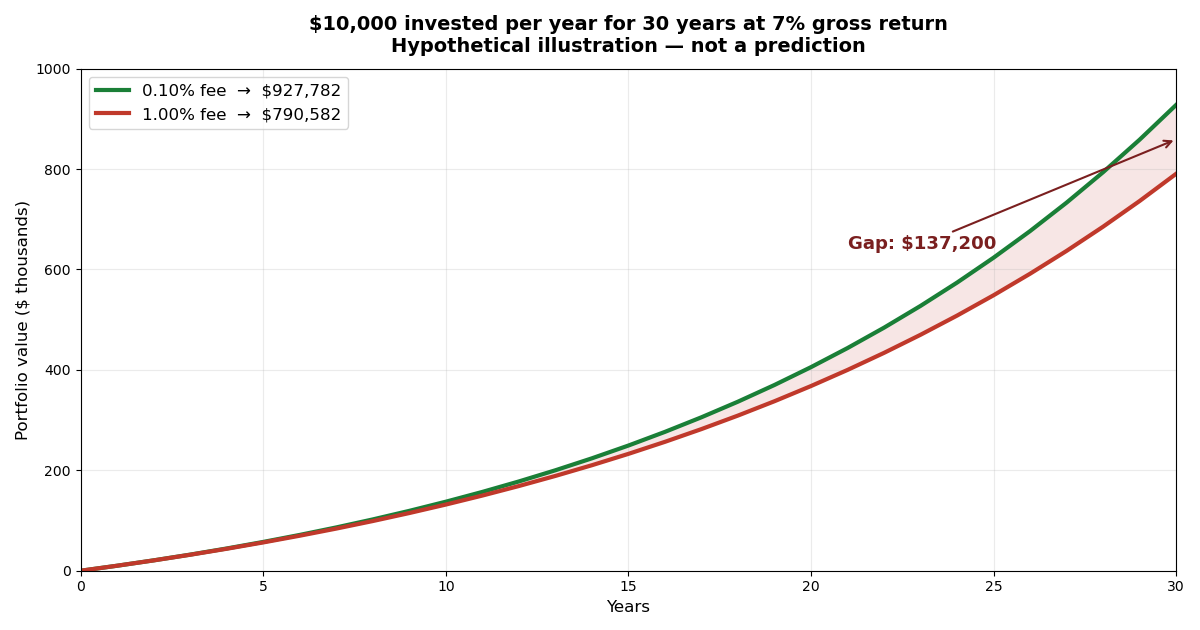
Here's the cruel part: you don't just lose the fee. You lose everything that money would have earned had it stayed invested. That's why a "tiny" 1% compounds into a six-figure shortfall. Run the same illustration over 40 years and the gap approaches $400,000.
Where the 1% hides
A 1% fee rarely announces itself. Here's where to look:
- Your 401(k) fund menu. Many plans default new savers into actively managed funds charging 0.5%–1% or more, while an index option at a fraction of the cost sits a few clicks away. If your employer offers a managed-account service, check what it charges too — see Should I use Financial Engines to manage my 401K?
- Advisor fees. A 1% annual fee on assets under management is the same math wearing a suit. (On automated alternatives, see How to Avoid Portfolio Mistakes with a Robo-Advisor.)
- 12b-1 and marketing fees, bundled invisibly inside the expense ratio of many mutual funds.
- Rollovers and fund mergers that quietly move you into a pricier share class of essentially the same fund — always compare the expense ratio before and after.
How to check yours in 10 minutes
- Log in to each investment account — 401(k), IRA, brokerage — and open your holdings.
- Find the expense ratio for each fund. It's also disclosed in the fund's prospectus fee table.
- Write the numbers down. Anything dramatically higher than a broad-market index fund deserves a closer look — compare it against the cheaper options available in the same account.
- In a 401(k), check whether your plan offers lower-cost share classes or index alternatives. Your plan administrator or HR benefits contact can confirm what's available.
The honest downside
No strategy is free of trade-offs, and fees are no exception:
- A low fee doesn't guarantee good returns. An index fund still falls when the market falls — you'll just fall slightly less than the expensive version of the same ride.
- Some active funds do beat their benchmarks. The hard part is identifying them in advance, which decades of evidence suggest is extremely difficult — and last decade's winners rarely repeat.
- Taxes can bite. In a taxable brokerage account, selling one fund to buy a cheaper one can trigger capital gains taxes. (Inside a 401(k) or IRA, swapping funds generally has no tax consequence.) Factor that in before moving money around.
Bottom line
You can't control what the market returns. You can control what you pay to participate in it — and it's one of the few investing variables entirely in your hands. In the 30-year illustration above, the difference between a 0.10% fee and a 1.00% fee is $137,200. Ten minutes with your account statements is among the highest-paid hours in personal finance. And if any of this touches decisions about your own accounts, consider running it by a fiduciary financial advisor first — ideally one who charges by the hour or project, not a percentage of your assets.
Looking for more ways to keep more of what you earn? Start with Building a Financial Plan – Part 1.
Sources
- U.S. Securities and Exchange Commission, Office of Investor Education and Advocacy, "How Fees and Expenses Affect Your Investment Portfolio" (Investor Bulletin), investor.gov — accessed September 25, 2026. Portfolio figures ($208,000 / $198,000 / $179,000) are the SEC's illustration: $100,000 at 4% annual growth over 20 years.
- 30-year and 40-year figures are the author's own calculations: $10,000 invested annually at a 7% average gross return, with fees of 0.10% vs 1.00%. Hypothetical illustration, not a prediction.


